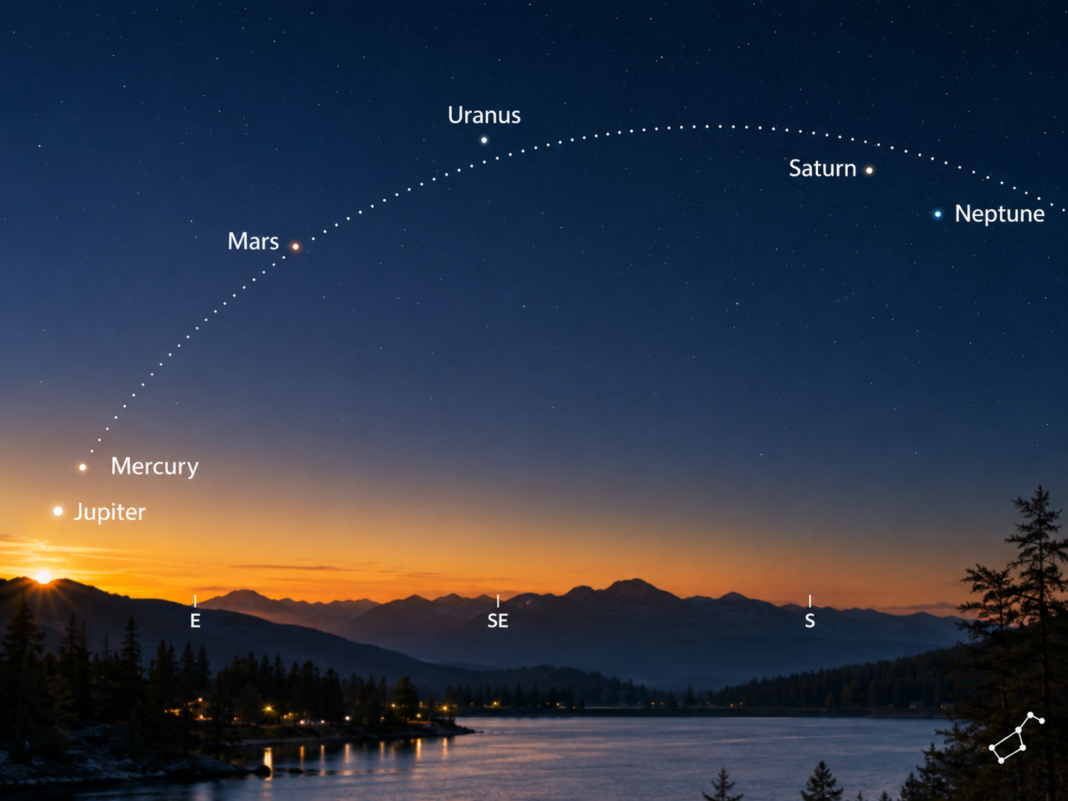

Stargazers and astronomy enthusiasts are treated to a rare celestial event as six planets—Jupiter, Mercury, Mars, Uranus, Saturn, and Neptune—align in the pre-dawn sky on Wednesday, August 12, 2026.
While not a formal scientific term, this phenomenon is widely referred to as a “planetary parade.” According to NASA, planets appear to align along an imaginary arc across the sky called the ecliptic when viewed from Earth. However, an alignment of six planets does not mean all will be visible to the naked eye. While Mercury, Mars, Jupiter, and Saturn can typically be spotted without equipment under clear conditions, viewing Uranus requires binoculars, and Neptune demands a high-powered telescope.
Astronomers note that visibility heavily depends on a clear, unobstructed horizon and dark sky conditions before sunrise, particularly for low-altitude planets like Mercury and Jupiter. Experts also emphasize that a planetary parade is an optical perspective from Earth rather than a physical straight line in deep space.