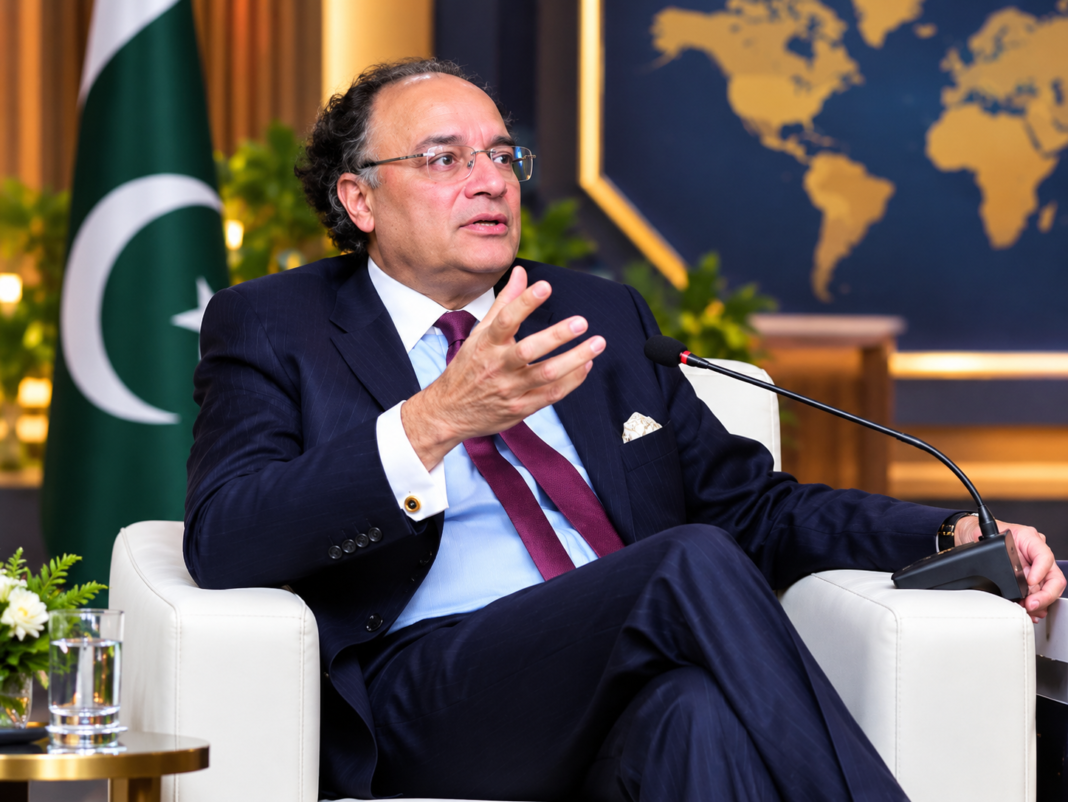

Federal Minister for Finance and Revenue, Senator Muhammad Aurangzeb, addressed a special session at the JPMorgan Emerging and Frontier Markets Opportunities Conference in London, emphasizing that Pakistan is transitioning from a phase of macroeconomic stabilization toward broad-based capital formation and sovereign recovery.
Highlighting the government’s strategic shift toward private-sector-led growth, productivity, and exports, the Finance Minister drew strong interest from major global institutional investors. A total of 55 global investment funds participated in one-on-one meetings and a comprehensive investor session alongside the Pakistani delegation, with Amin Khwaja, CEO and Country Head of JPMorgan Pakistan, also in attendance.
Outlining the government’s economic roadmap, Aurangzeb detailed six core priorities:
- Sustaining macroeconomic resilience and reinforcing fiscal shock-absorption capacity.
- Transitioning from stability to productivity-, investment-, and export-led growth.
- Continuing structural reforms and shifting from aid reliance to robust trade and investment.
- Broadening financial inclusion across various segments of society.
- Preparing Pakistan for the digital economy, including blockchain and Web 3.0 technologies.
Reviewing the past three years of rebuilding economic credibility, the minister noted that FY2026 GDP growth recovered to 3.7%, the fiscal deficit narrowed to a multi-year low of 2.6% of GDP, and the country recorded a primary surplus for the third consecutive year. State Bank of Pakistan Governor Jamil Ahmed also underscored improvements in external buffers, foreign exchange reserves, rising worker remittances, and stabilizing inflation.
Furthermore, the Finance Minister detailed successful returns to international capital markets through diverse financial instruments, including Pakistan’s debut Panda bond and a record $3 billion two-tranche Eurobond transaction. To crowd in private capital and downscale state involvement in commercial sectors, ongoing enterprise privatizations—such as PIA and power distribution companies (DISCOs)—alongside a National Private Equity Framework are being aggressively advanced.