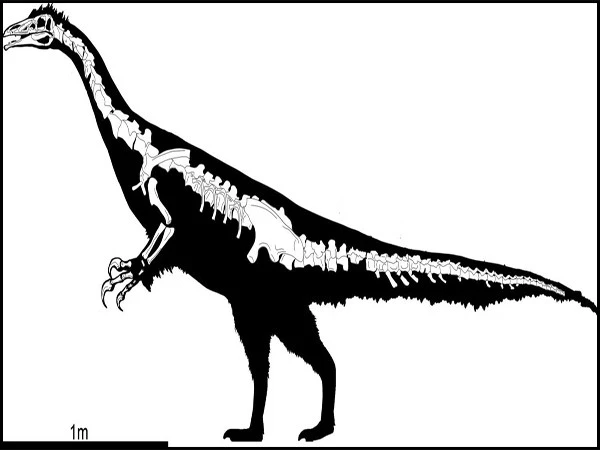

Researchers have discovered a brand-new species of long-clawed dinosaur in northeastern China, unearthing unique anatomical features from an exceptionally well-preserved fossil specimen.
Named Qerasaurus changliensis (transliterated), the creature belonged to a bipedal group of dinosaurs known as therizinosaurs, which are famous for possessing unusually large and prominent claws on their forelimbs. Researchers note that this stands as one of the most distinctive discoveries of its kind.
Previously discovered therizinosaurs shared several bizarre traits, including relatively small heads, long necks, leaf-shaped teeth, and razor-sharp forelimb claws. Q. changliensis was officially classified as a distinct species after paleontologists recovered a nearly complete skull and skeletal structure from the Jehol Biota fossil formation in western Liaoning.
The fossil site in northeastern China dates back roughly 135 to 121 million years, a geological region renowned globally for yielding pristine feathered and unique dinosaur specimens. The recovered fossil belonged to a sub-adult individual measuring approximately 3.6 meters from head to tail. While direct weight measurements were impossible due to missing leg bones, researchers estimate based on close evolutionary relatives that its weight ranged between 117 to 274 kilograms, with fully mature adults likely weighing significantly more. Detailed analysis of the skull also revealed densely packed, small teeth, with the lower jaw housing upwards of 45 teeth.