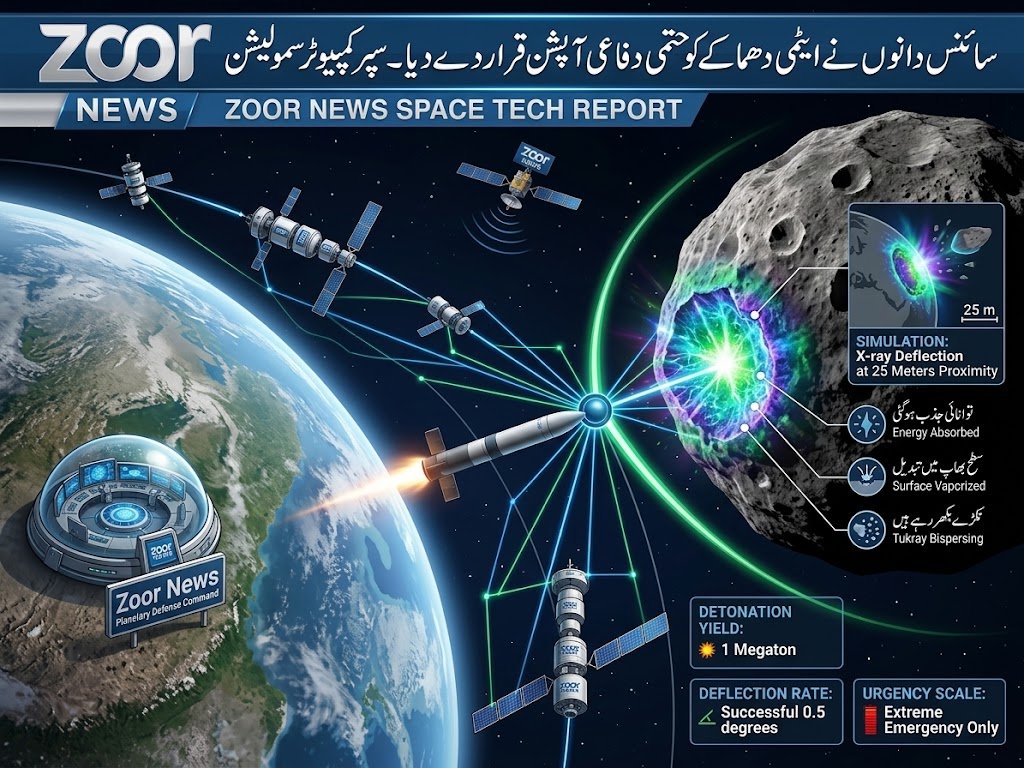

Scientists exploring planetary defense mechanisms have found that a targeted nuclear detonation could effectively destroy or alter the trajectory of a large asteroid heading toward Earth.
Researchers at the Lawrence Livermore National Laboratory (LLNL), led by Isaiah Santistevan, utilized supercomputers to simulate the impact of a one-megaton nuclear blast detonated a few meters away from a 160-meter-wide asteroid—roughly the size of a football stadium. The findings indicate that direct impact is unnecessary; intense X-ray radiation released by the explosion vaporizes the asteroid’s surface material, generating a powerful shockwave that shifts its direction and breaks the rock into smaller fragments.
During testing across different distance parameters, simulations demonstrated that a detonation occurring 25 meters away dispersed X-rays over a broader surface area, causing substantial initial structural damage. However, researchers emphasize that nuclear intervention remains an extreme last-resort option. Uncertainties remain regarding whether the resulting fragments would safely scatter into deep space or reaggregate under gravity over time.