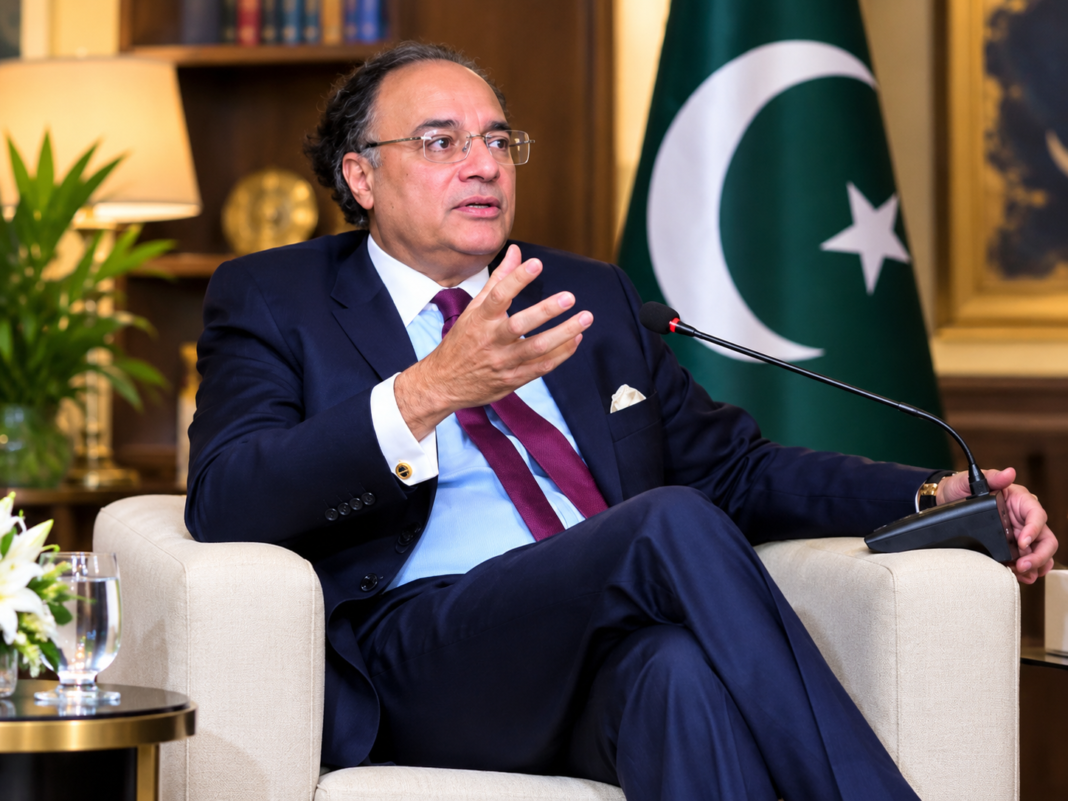

.Federal Minister for Finance and Revenue, Senator Muhammad Aurangzeb, stated that Pakistan is transitioning from economic stability and sovereign recovery toward broad-based capital formation. Addressing a special session at the JPMorgan Emerging and Frontier Markets Opportunities Conference in London, the Finance Minister detailed the country’s macroeconomic recovery, external pressures, and future economic strategies.
Highlighting priority shifts toward private-sector-led growth, investment, and exports, the minister noted strong interest from major global institutional investors and fund managers. A total of 55 global investment funds participated in one-on-one meetings and a plenary investor session alongside a Pakistani delegation. Amin Khwaja, CEO and Country Head of JPMorgan Pakistan, was also present during the discussions.
Outlining the government’s economic roadmap, Aurangzeb highlighted six core pillars: sustaining macroeconomic resilience, transitioning from stability to productivity-led growth, maintaining structural reforms, moving from aid to trade and investment, broadening financial inclusion, and positioning Pakistan for the digital economy, including blockchain and Web 3.0. Reviewing the past three years of rebuilding economic credibility, he noted that FY2026 GDP growth recovered to 3.7%, the fiscal deficit narrowed to a multi-year low of 2.6% of GDP, and the country recorded a primary surplus for the third consecutive year.
State Bank of Pakistan Governor Jamil Ahmed also underscored improvements in external buffers, foreign exchange reserve quality, and rising worker remittances. Furthermore, the Finance Minister detailed successful returns to international capital markets through transactions like Pakistan’s debut Panda bond and a record $3 billion two-tranche Eurobond. To encourage private sector participation, ongoing state enterprise privatization—including PIA and DISCOs—alongside a National Private Equity Framework are being advanced.